Posts

Tarrou's world

Image
  I believe I had some semblance of a rendezvous with the author through the passage in which Tarrou finally emerges as the one witness who is able to see OR the one who happens to consider those elements of 'reality' which invariably transgress the so claimed realist real of life. And in so doing guides the reader towards the point where the 'real' wedges with the existence's absurdity. This moment would also develop into triggering him to reflect upon things more digressively. You cannot extract away the real and concrete from Camus's 'The Plague'; however, the real is as much unreal (in the sense of the elements usually removed by a limited observation). Tarrou doesnt just sees, but 'pictures', listens, and feels his observations. This necessary philosophic and implicitly artistic stance beckons the reader to situate itself in a more moderate manner to face the twining of the real and the banal, as well as the more absurd questions that the su...

words, words, words ...

Resting his hand on a protruding stone, the man raised his trunk and, as if sleepwalking, the horse followed hi effortlessly, with flowing movements which seemed weightless. And the centaur emerged into the night. ))    José Saramago,  The Centaur
Image
The Lives of Things by José Saramago My rating: 4 of 5 stars 'The Lives of Things' is a collection of six short stories originally published as 'Objecto Quase' in 1978. The epigraph by Marx marks, uninhibitedly, themes political and social which the author essentially elaborated upon in his later fiction, especially in 'The Stone Raft', 'The Cave' and the tour de force, 'Blindness'.   'The Chair' opens the book, in the stream of consciousness narration, and obliquely reflects on the political state of affairs under the Salazar regime. The subject of the fall of the chair takes the reader on a trip to imagine, understand and question the conceptual contours of this fall which, in the case, was inevitable. Still, the approach of presenting the manifestation of the rot, the behind-the-scenes work of an essential and yet seemingly inadvertent opposition set up by the too much-ness of one's proclaimed authority, is tongue in cheek to say...

A journey indeed...

“The journey is never over. Only travellers come to an end.” Saramago ends this wonderful book on a note which is most most appropriate in the hands of a master storyteller. One really ‘feels priviledged’ in the company of a sensitive writer; sensitive to the place he belongs to, a place which is effortlessly shown to us to be more than just a place. I had started Journey to Portugal a few months ago and I knew right away that it is just the way with this book. I literally savoured the descriptions of the country in the words of an author whose novels, almost consciously, avoid being set within definitive spaces of geography. The Journey , however, is about Portugal from the eyes of the ‘traveller’. I must start by saying that the experience had been unlike all others; I’d never read a travelogue from the point of view of a traveller with keen sense of imagination and appreciation of things witnessed by him. The journey is beautifully given a start by the element of a...

Discovering Lisbon

I am wondering why the traveller’s much anticipated visit to Lisbon starts on a somewhat dejected and somber note. Here he is, ready to witness the marvel of this port city, the museums and the monasteries whose architecture takes you on a journey through various ages. But all he could muster is the bitter memories evoked by objects revealing horrendous crimes committed in the past. He is thankful to the museums for preserving some of the objects in order to testify what, according to him, is “necessary” for us to remember. The traveller is clearly occupied with these thoughts as his indecision gives way to questioning: “The traveler regains the street and feels lost. Where should he go now? What is he to visit? What shall he leave aside, either on purpose or because of the impossibility of seeing and commenting on everything? And anyway, what does it mean to see everything?” ~ Journey to Portugal

The traveller reaches Lisbon

"So finally, here is Lisbon. But before undertaking the adventure, which he finds somewhat intimidating, the traveller wants to visit the village on the estuary known as Carcavelos, to see something that few people know about, when you think of the million inhabitants of Lisbon and the thousands who come to this coast, that is, to conclude, the parish church." ~ Journey to Portugal As I begin reading the final third of this book, the 'traveller' looks as excited as ever and this turn is placed in such a way as if the whole travelogue had been busy in preparation for a visit to Lisbon, though appearances could still be deceptive. Strangely enough, the church and its architecture seems to be the element of the traveller's interest. There is no place devoid of it. Saramago, I reckon, intends to infuse various elements of Portuguese culture and is careful to include both the landscape and the art that adopts it. This is the reason why this book is more than a trave...

The Raisonneur(s)

            … and blest are those Whose blood and judgment are so well commingled That they are not a pipe for fortune’s finger To sound what stop she please. Give me that man That is not passion’s slave and I will wear him In my heart’s core—aye, in my heart of heart, As I do thee. Hamlet’s words for his friend and raisonneur, Horatio. As I miss the character of Hamlet today, I know the play calls for another reading which I suppose will get tended to soon. But let me first dedicate this post and its quote to all those who could relate to the position of Hamlet, reading these lines. The presence of a calm friend who listens when it is needed the most is a measure of great strength indeed.

Poem

This is in response to my friend's beautiful postcard-pictures to inspire and create something in return. http://sonamdema.blogspot.com/2011/06/in-love-again.html And so I have; come up with a spontaneous verse I hope to have justified with the effort spent behind the camera. The title of the poem is not mine; for it got 'inspired'.          In love again Is it the breeze that instills Rustling wind of the reeds, Or nature's light which fills My prism'd heart, a vibrance of beads. I do not quite know What it brings on its wings. But my vision is worth the glow Astride a pathless trail when it sings. Sings it the song I once loved at school.. Brings it along the wonders that belong. Fills it forevermore the fields we then thronged.. Sees it I imagine once again my lost jewel. Through the stone-streets have I walked. Treaded many a witness to the fields. But lo! the hut calls me thither again, 'Blue of the sky' i...

Remembering with rememberance of words

Image
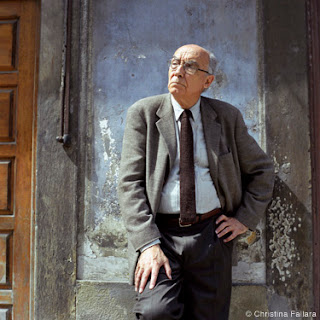
On the first death anniversary of José Saramago, I can't help but remember and reminisce the worlds of words he so perseveringly weaved into narratives which, to me, are blessed with the author's literary voice that has forever become a part of my understanding of human existence. Replete foremostly with human emotion and an ever so patient motherly touch in such unforgettable characters like Blimunda, Lydia and Death, each book of his I have picked and read so far, has made me feel more rooted into the ground we all need to stand upon. Abound with astounding imagination, Saramago's writing could easily be credited with playing a conscious role of constantly contesting 'our' sense of reality (as well as illusion).      The run-on sentence with an aural felicity beckons a reader's delight (provided the reader is able to give in wholly to the perspectival imagination of the written word). Challenging the notions of the world we inhabit, Saramago's books ca...

Food for thought

Do you disagree to agree in a mindful situation’s mindless worth which is worthless to the extent of saying the unsaid over time’s timelessness? Or stay weary of the everlasting neverthelessness from a perspectival want for perspectives? Have we understood the absence of a surface we keep sticking to even when what is not in sight views itself in the reflection of a mirage that had accompanied the trails we thought we left but were due to appear in the course of events which are yet to manifest? This and a lot more which cannot be this is the subject of a thought whose objective sense contests all appearances in the disappearance of an existence whose ethereal self helps to unlock the real essence of a dream not yet dreamt by the best of the rest. Afterthought:  NEVERMIND

A Traveller's time.

Reading this wonder of a book: Journey to Portugal/ Viagem a Portugal. I am almost halfway through. It is one of those few books which, for all its descriptions and digressions, remains honest to the 'Journey'. I feel enchanted to find that this book travels at its own pace. I just cannot help it. But with that I mean something important I realise now with reading the kind I am dealing with. By taking me the reader at its own pace it shows how much the book is in control of the opposite side. As I sail through these pages quite snail like; happily, I bring in a line from the author and rest shall resume:        For a butterfly born with the morning and dying before dusk, night does not exist.

Poem

Image
   'The Wattle Tree'     by  Dora  Wilcox Winter is not yet gone - but now The birds are carolling from the bough. And the mist has rolled away Leaving more beautiful the day. The sun is out - O come with me To look upon the wattle tree! Let misers hoard and hide their gold; Here there is treasure-trove untold, In yellow blossom, mass on mass Spread out for wayfarers who pass With hearts to feel, and eyes to see How lovely is the wattle tree. O strange, O magical! to forget For a moment care and fret, Whilst the next spirit, like a cup Drained of delight, again fills up And overflows with ecstasy Before the miracle of the tree. And rich and poor, who pause to bless The shining tree in thankfulness, Are bound in fellowship indeed. What matter politics or creed, Or class or colour? surely he Loves mankind who loves a Tree! Towards illimitable skies From the earth the trees arise: Givers of Joy, their gold ...

The knock of words . . .

The last three months, it seems, have had a whirlpool-whirlwinding effect on me. Intermittent travelling and having to deal with things bit unwillingly resulted in lack of reading or putting the mind to thought. A phase which wouldn't have been complete without my own lazy lack of interest and initiative. Words accompanied me nonetheless.  Here's a reflection on the few I did remember; and wanted to quote: A writer is a person who cares what words mean, what they say, how they say it. Writers know words are their way towards truth and freedom, and so they use them with care, with thought, with fear, with delight. By using words well, they strengthen their souls. Story-tellers and poets spend their lives learning that skill and art of using words well. And their words make the souls of their readers stronger, brighter, deeper. URSULA LE GUIN

Birthday''' today: John KEATS...

Hey people. I am back on my page after a while this time. I don't like it. Feel I 'll have to pen a song dedicating to myself. And the way it goes, it will have no other title than, 'My Lazy Dreams'. And so I thought I will mark today as the day of my return to the page. Let me jot down some of my favourite quotes as essenatial echoes of the poet who died young but will live forever through his words... We remember John Keats today... and feel the power of words in our faces... once again. _____________________________________________ I am in that temper that if I were under water I would scarcely kick to come to the top. ~  John  Keats ______________________________________________ I have two luxuries to brood over in my walks, your loveliness and the hour of my death. O that I could have possession of them both in the same minute. ~  John  Keats _______________________________________________ My imagination is a monastery and I am its monk. ~...

The Things we can do...

It is October. A fresh start to the final phase of the year. This time marks few occasions worth remembering... England will celebrate Children's Book Week. Countries as far as Cyprus and Nigeria share the Independence day today. It is the International day for Non-violence tomorrow. On the 5th, we have International World Teachers' day. For the United States, October is the National Arts & Humanities Month. In India, Rajasthan gears up for the International Folk festival, while Bhutan celebrates Jampa Lhakhang Drup Festival later this month. I guess that will do to let people 'go out' and celebrate; to mark the occasions with colours and smiles. We will talk and resolve, teach the young and join hands with the old. We commit ourselves to the nation, and revere the Arts. Each occasion is valued and marked by the community followers. While these events and more take place, I would like to enthuse our genial spirits, trying to infuse our sense of actions and ...

View 2

Reading this amazing novel ( Death at Intervals ) by Saramago. Oh,, what can I say about it... The more you read Saramago, the more enchanted you feel. Food for thought! Yes, feels as if this guy is inexhaustible. In this book, he plays with the idea of Death. I am at the place where it is best to be in a good book: right in the middle of it. Woof, what unbelievable pages I am reading; these are some thoughts that Saramago, taking you by the arm, show once; then twice. At this stage of the book, I’d share a thought that he’s held in his arms for us to hold and think about: "By the way, we feel we must mention that death, by herself and alone, with no external help, has always killed far less than mankind has."  p. 98 In the context of the narrative, these words appear at a point, where you are taken aback, with eyes opening to the extent of your mind noticing it. The pages that follow, have opened up the argument in the most subtle of wa...

Untitled 24

Hello everyone... Its been a few days since I posted my last. What has made do it today is my coming across certain words... It is my first meeting with the (words of) Polish poet Czeslaw Milosz, and I will soon learn the correct pronunciation of the name :)  Well, I read a few poems by him today... and boy oh boy... words can move the heaviest stone, I say. There is something which stirs inside you, reading a word followed by another and then another... till the immovable stone has already moved under its own weight; with the movement, you catch the beat of your heart... Would like to share with you, one poem by Czeslaw Milosz: . . .                        Love Love means to learn to look at yourself The way one looks at distant things For you are only one thing among many. And whoever sees that way heals his heart, Without knowing it from various ills A bird and a tr...

First Impressions...

Finished the book that has had a few rounds on this blog: The Cave . As a general practice, after finishing a novel, I rush to find some well written reviews on the book that I'd picked, held and savoured literally. :-) The reason for this hasn't got so much to do with the desire to know more on the themes etc. , as it is with the immediate and natural feeling to share your reading with someone. And since I normally end up in vain in finding reciprocating voices to share something like reading, one of the best things to do is to search and find few other pages of writing which, given a chance, could speak to you about that reading on similar terms of understanding. It also helps to come across varying points of view ( find many I argue with vehemently :) ). Anyway, to review the book on my own is going to utilise energy elsewhere and for another time ( hope that comes soon), but what takes most of my imagination, after stepping over the threshold of a novel's ending, is ...

Reading of a book

Read some pages from Saramago’s The Cave today. I am so delighted to read these lines that I want to share them with you. Couldn’t help it really. I am halfway through this novel. It is a simple story about a small family. The head of the family, Cipriano Algor, wakes up early in the morning one day, to complete some work. He gets up and decides to go out and see the following:         “The dense foliage of the mulberry tree still had a firm grip on night, it would not let it leave just yet, the first dawn twilight would linger for at least another half an hour. He glanced at the kennel then looked around him, surprised not to see the dog. He gave a low whistle, but there was still no sign of Found. The potter went from perplexed surprise to outright concern, I can’t believe he’s just gone, he muttered. He could call out the dog’s name, but he did not want to alarm his daughter. He’ll be out there somewhere, on t...

QuoteS of the day

  Feel like posting some quotes with the word 'echo'.    Activities like reading, writing, and thinking, essentially have words at their disposal as echoes of something I mightn't be able to name. Perhaps that's the reason we should let these echoes be. As is presented time and again by authors of good literature, something becomes an irrefutable spark which is given some form with the bits we call words. These echoes belong to everyone; and that is why the creator shares it by freeing it from the struggling, fidgeting artist's inadvertent grasp.   "Perhaps the same bird echoed through both of us yesterday, separate, in the evening."                                                   ...