Posts

Showing posts with the label Saramago
Image
The Lives of Things by José Saramago My rating: 4 of 5 stars 'The Lives of Things' is a collection of six short stories originally published as 'Objecto Quase' in 1978. The epigraph by Marx marks, uninhibitedly, themes political and social which the author essentially elaborated upon in his later fiction, especially in 'The Stone Raft', 'The Cave' and the tour de force, 'Blindness'.   'The Chair' opens the book, in the stream of consciousness narration, and obliquely reflects on the political state of affairs under the Salazar regime. The subject of the fall of the chair takes the reader on a trip to imagine, understand and question the conceptual contours of this fall which, in the case, was inevitable. Still, the approach of presenting the manifestation of the rot, the behind-the-scenes work of an essential and yet seemingly inadvertent opposition set up by the too much-ness of one's proclaimed authority, is tongue in cheek to say...
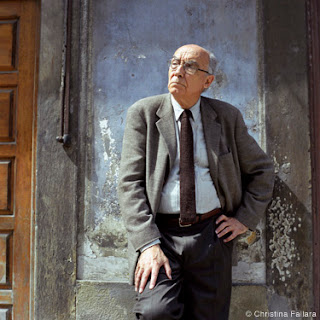
A journey indeed...

“The journey is never over. Only travellers come to an end.” Saramago ends this wonderful book on a note which is most most appropriate in the hands of a master storyteller. One really ‘feels priviledged’ in the company of a sensitive writer; sensitive to the place he belongs to, a place which is effortlessly shown to us to be more than just a place. I had started Journey to Portugal a few months ago and I knew right away that it is just the way with this book. I literally savoured the descriptions of the country in the words of an author whose novels, almost consciously, avoid being set within definitive spaces of geography. The Journey , however, is about Portugal from the eyes of the ‘traveller’. I must start by saying that the experience had been unlike all others; I’d never read a travelogue from the point of view of a traveller with keen sense of imagination and appreciation of things witnessed by him. The journey is beautifully given a start by the element of a...

Discovering Lisbon

I am wondering why the traveller’s much anticipated visit to Lisbon starts on a somewhat dejected and somber note. Here he is, ready to witness the marvel of this port city, the museums and the monasteries whose architecture takes you on a journey through various ages. But all he could muster is the bitter memories evoked by objects revealing horrendous crimes committed in the past. He is thankful to the museums for preserving some of the objects in order to testify what, according to him, is “necessary” for us to remember. The traveller is clearly occupied with these thoughts as his indecision gives way to questioning: “The traveler regains the street and feels lost. Where should he go now? What is he to visit? What shall he leave aside, either on purpose or because of the impossibility of seeing and commenting on everything? And anyway, what does it mean to see everything?” ~ Journey to Portugal

The traveller reaches Lisbon

"So finally, here is Lisbon. But before undertaking the adventure, which he finds somewhat intimidating, the traveller wants to visit the village on the estuary known as Carcavelos, to see something that few people know about, when you think of the million inhabitants of Lisbon and the thousands who come to this coast, that is, to conclude, the parish church." ~ Journey to Portugal As I begin reading the final third of this book, the 'traveller' looks as excited as ever and this turn is placed in such a way as if the whole travelogue had been busy in preparation for a visit to Lisbon, though appearances could still be deceptive. Strangely enough, the church and its architecture seems to be the element of the traveller's interest. There is no place devoid of it. Saramago, I reckon, intends to infuse various elements of Portuguese culture and is careful to include both the landscape and the art that adopts it. This is the reason why this book is more than a trave...

Remembering with rememberance of words

Image
On the first death anniversary of José Saramago, I can't help but remember and reminisce the worlds of words he so perseveringly weaved into narratives which, to me, are blessed with the author's literary voice that has forever become a part of my understanding of human existence. Replete foremostly with human emotion and an ever so patient motherly touch in such unforgettable characters like Blimunda, Lydia and Death, each book of his I have picked and read so far, has made me feel more rooted into the ground we all need to stand upon. Abound with astounding imagination, Saramago's writing could easily be credited with playing a conscious role of constantly contesting 'our' sense of reality (as well as illusion).      The run-on sentence with an aural felicity beckons a reader's delight (provided the reader is able to give in wholly to the perspectival imagination of the written word). Challenging the notions of the world we inhabit, Saramago's books ca...

View 2

Reading this amazing novel ( Death at Intervals ) by Saramago. Oh,, what can I say about it... The more you read Saramago, the more enchanted you feel. Food for thought! Yes, feels as if this guy is inexhaustible. In this book, he plays with the idea of Death. I am at the place where it is best to be in a good book: right in the middle of it. Woof, what unbelievable pages I am reading; these are some thoughts that Saramago, taking you by the arm, show once; then twice. At this stage of the book, I’d share a thought that he’s held in his arms for us to hold and think about: "By the way, we feel we must mention that death, by herself and alone, with no external help, has always killed far less than mankind has."  p. 98 In the context of the narrative, these words appear at a point, where you are taken aback, with eyes opening to the extent of your mind noticing it. The pages that follow, have opened up the argument in the most subtle of wa...

First Impressions...

Finished the book that has had a few rounds on this blog: The Cave . As a general practice, after finishing a novel, I rush to find some well written reviews on the book that I'd picked, held and savoured literally. :-) The reason for this hasn't got so much to do with the desire to know more on the themes etc. , as it is with the immediate and natural feeling to share your reading with someone. And since I normally end up in vain in finding reciprocating voices to share something like reading, one of the best things to do is to search and find few other pages of writing which, given a chance, could speak to you about that reading on similar terms of understanding. It also helps to come across varying points of view ( find many I argue with vehemently :) ). Anyway, to review the book on my own is going to utilise energy elsewhere and for another time ( hope that comes soon), but what takes most of my imagination, after stepping over the threshold of a novel's ending, is ...

Reading of a book

Read some pages from Saramago’s The Cave today. I am so delighted to read these lines that I want to share them with you. Couldn’t help it really. I am halfway through this novel. It is a simple story about a small family. The head of the family, Cipriano Algor, wakes up early in the morning one day, to complete some work. He gets up and decides to go out and see the following:         “The dense foliage of the mulberry tree still had a firm grip on night, it would not let it leave just yet, the first dawn twilight would linger for at least another half an hour. He glanced at the kennel then looked around him, surprised not to see the dog. He gave a low whistle, but there was still no sign of Found. The potter went from perplexed surprise to outright concern, I can’t believe he’s just gone, he muttered. He could call out the dog’s name, but he did not want to alarm his daughter. He’ll be out there somewhere, on t...

Pondering...

The first entry of this blog used as its title a phrase that is dear to me. Preponderant ponderability. I could imagine a few stalwarts of literature who, for me, exercise it in their work. Wilde, Hesse, Proust, Bellow, Saramago, and the heavyweight, Shakespeare. In the last post, echoes of words found pages of a novel I am reading these days, The Cave. I consider myself fortunate to have read some books by Saramago and the few that are left, beckon me everyday.                 It has been two months today, since I read about the news of the artist’s death. Ever since, having come across pages of sudden dedication as well as criticism, I have felt a strong desire to write about my thoughts and experience on reading his work. So much so that I decided, after posting my last last night, to create some sort of an exclusive space for one of my favourite writer.   ...

Beginning of a beginning

One who lets words be, knows they are capable of the occasional wonders and surprises that spring right in front of you just when you have lost all hope and have had your share of contemplation of the Hamletian murmur, "Words, words, words."       The opening of fifth chapter of José Saramago's The Cave , adresses a similar predicament. To my utter surprise, the words on the page complemented the exact problem that had occupied a good portion my day today. The problem of a beginning. How do we begin anything? How does that thing begin which, before its much anticipated inception has been pondered on lest something turns out into a chaos? The fear of beginning a thing (like a creative initiative, a responsible task for one's job) is something, I believe, a lot of you could share with me. How to begin your writing? How do we begin teaching in a class even? What repercussions can, a not so discreet, a beginning have on the res...