The Lives of Things by José Saramago My rating: 4 of 5 stars 'The Lives of Things' is a collection of six short stories originally published as 'Objecto Quase' in 1978. The epigraph by Marx marks, uninhibitedly, themes political and social which the author essentially elaborated upon in his later fiction, especially in 'The Stone Raft', 'The Cave' and the tour de force, 'Blindness'. 'The Chair' opens the book, in the stream of consciousness narration, and obliquely reflects on the political state of affairs under the Salazar regime. The subject of the fall of the chair takes the reader on a trip to imagine, understand and question the conceptual contours of this fall which, in the case, was inevitable. Still, the approach of presenting the manifestation of the rot, the behind-the-scenes work of an essential and yet seemingly inadvertent opposition set up by the too much-ness of one's proclaimed authority, is tongue in cheek to say...
Posts
A journey indeed...
- Get link
- X
- Other Apps
“The journey is never over. Only travellers come to an end.” Saramago ends this wonderful book on a note which is most most appropriate in the hands of a master storyteller. One really ‘feels priviledged’ in the company of a sensitive writer; sensitive to the place he belongs to, a place which is effortlessly shown to us to be more than just a place. I had started Journey to Portugal a few months ago and I knew right away that it is just the way with this book. I literally savoured the descriptions of the country in the words of an author whose novels, almost consciously, avoid being set within definitive spaces of geography. The Journey , however, is about Portugal from the eyes of the ‘traveller’. I must start by saying that the experience had been unlike all others; I’d never read a travelogue from the point of view of a traveller with keen sense of imagination and appreciation of things witnessed by him. The journey is beautifully given a start by the element of a...
Discovering Lisbon
- Get link
- X
- Other Apps
I am wondering why the traveller’s much anticipated visit to Lisbon starts on a somewhat dejected and somber note. Here he is, ready to witness the marvel of this port city, the museums and the monasteries whose architecture takes you on a journey through various ages. But all he could muster is the bitter memories evoked by objects revealing horrendous crimes committed in the past. He is thankful to the museums for preserving some of the objects in order to testify what, according to him, is “necessary” for us to remember. The traveller is clearly occupied with these thoughts as his indecision gives way to questioning: “The traveler regains the street and feels lost. Where should he go now? What is he to visit? What shall he leave aside, either on purpose or because of the impossibility of seeing and commenting on everything? And anyway, what does it mean to see everything?” ~ Journey to Portugal
The traveller reaches Lisbon
- Get link
- X
- Other Apps
"So finally, here is Lisbon. But before undertaking the adventure, which he finds somewhat intimidating, the traveller wants to visit the village on the estuary known as Carcavelos, to see something that few people know about, when you think of the million inhabitants of Lisbon and the thousands who come to this coast, that is, to conclude, the parish church." ~ Journey to Portugal As I begin reading the final third of this book, the 'traveller' looks as excited as ever and this turn is placed in such a way as if the whole travelogue had been busy in preparation for a visit to Lisbon, though appearances could still be deceptive. Strangely enough, the church and its architecture seems to be the element of the traveller's interest. There is no place devoid of it. Saramago, I reckon, intends to infuse various elements of Portuguese culture and is careful to include both the landscape and the art that adopts it. This is the reason why this book is more than a trave...
The Raisonneur(s)
- Get link
- X
- Other Apps
… and blest are those Whose blood and judgment are so well commingled That they are not a pipe for fortune’s finger To sound what stop she please. Give me that man That is not passion’s slave and I will wear him In my heart’s core—aye, in my heart of heart, As I do thee. Hamlet’s words for his friend and raisonneur, Horatio. As I miss the character of Hamlet today, I know the play calls for another reading which I suppose will get tended to soon. But let me first dedicate this post and its quote to all those who could relate to the position of Hamlet, reading these lines. The presence of a calm friend who listens when it is needed the most is a measure of great strength indeed.
Poem
- Get link
- X
- Other Apps
This is in response to my friend's beautiful postcard-pictures to inspire and create something in return. http://sonamdema.blogspot.com/2011/06/in-love-again.html And so I have; come up with a spontaneous verse I hope to have justified with the effort spent behind the camera. The title of the poem is not mine; for it got 'inspired'. In love again Is it the breeze that instills Rustling wind of the reeds, Or nature's light which fills My prism'd heart, a vibrance of beads. I do not quite know What it brings on its wings. But my vision is worth the glow Astride a pathless trail when it sings. Sings it the song I once loved at school.. Brings it along the wonders that belong. Fills it forevermore the fields we then thronged.. Sees it I imagine once again my lost jewel. Through the stone-streets have I walked. Treaded many a witness to the fields. But lo! the hut calls me thither again, 'Blue of the sky' i...
Remembering with rememberance of words
- Get link
- X
- Other Apps
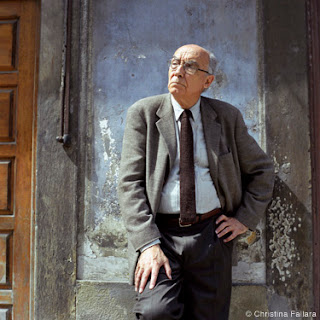
On the first death anniversary of José Saramago, I can't help but remember and reminisce the worlds of words he so perseveringly weaved into narratives which, to me, are blessed with the author's literary voice that has forever become a part of my understanding of human existence. Replete foremostly with human emotion and an ever so patient motherly touch in such unforgettable characters like Blimunda, Lydia and Death, each book of his I have picked and read so far, has made me feel more rooted into the ground we all need to stand upon. Abound with astounding imagination, Saramago's writing could easily be credited with playing a conscious role of constantly contesting 'our' sense of reality (as well as illusion). The run-on sentence with an aural felicity beckons a reader's delight (provided the reader is able to give in wholly to the perspectival imagination of the written word). Challenging the notions of the world we inhabit, Saramago's books ca...